Every weekend, all over the world, millions of parents, children and coaches set off for the same ritual: match day. Most will follow the same routine they always do, without ever questioning it.
Most of these parents and coaches are well-intentioned. They think they’re supporting their child and their team. What they don’t realise is the damage they’re doing by getting overly involved before, after, and most critically during the game itself.
I say ‘don’t realise’ because if they do realise, the situation on our touchlines is worse than I feared.

This morning, I ran a small experiment at an Under 8s grassroots football match. I counted every tactical instruction yelled from the sideline by parents and coaches to the children. In 40 minutes of play, there were 134. That figure doesn’t include positive praise so that’s 134 pieces of instruction, direction and correction alone.
Imagine you’re an adult, part-way through a task, and someone is shouting a new instruction at you roughly every 18 seconds. Now imagine some of those instructions contradict each other, you’d struggle to concentrate and you’d struggle to make the decisions you were already halfway through making. Now think about what that feels like for a child.
If parents and coaches aren’t aware of the damage this does, I hope this gives them something to think about.
Caught up in the excitement of the game, most parents and coaches genuinely believe that shouting technical or tactical instruction is helping. It might even look like it works, occasionally, in the short term. However, there are real, long-term costs for the player:
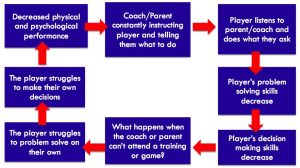
My message to parents
Are you shouting tactical instructions from the sidelines?
If the answer is yes — stop. Stop now.
I can already hear the justifications forming. I can already hear you rationalising your approach, because I could be you. I am you. I want to right the wrongs for my own child. I want him to score. I want him to feel the joy of winning, and I want to spare him the pain of losing. I want him to know I’m there, that I love him, that I’m his biggest fan.
But let me ask you this: do you think it helps?
It doesn’t.
No justification changes that. No clever counter argument gets round it. Screaming and shouting tactical instructions from the touchline is bad for your child. It’s that simple. I didn’t make it up.
My message to coaches
Everything above still applies to you, though there’s a little more room for a measured, considered word here and there if you’re genuinely trying to help your team develop.
We regularly hear from parents who’ve been told by their club exactly how they’re expected to behave on the sideline and then must stand and watch the coach do the opposite. Coaches must be the role models here leading from the front, and parents will follow. Say one thing and do another, and no amount of policy will hold the line.
What to do instead
Stopping the shouting doesn’t mean going silent and disengaged. It means changing what you’re offering from the sideline:
- Save the technical feedback for after the game, in the car, or better still, let the coach own it entirely.
- Offer encouragement, not direction — there’s a real difference between “come on!” and “get rid of it!”
- Let mistakes happen. A misplaced pass a child worked out for themselves teaches them more than one you shouted the correction to.
- Ask questions afterwards rather than giving answers during. “What did you enjoy?” tells you and them far more than “why didn’t you pass it?”
With positive support, and positive support only, on the touchline, we can start to regain control of an environment that’s genuinely at risk of spiralling. Right now, in its current state, the only people paying the long-term price are the ones we love the most and want the most for: the children.