‘What happens to us,’ I’m often asked, ‘that turns sensible, relaxed parents and coaches into stressed-out adults pacing the touchline, shouting instructions at every opportunity?’
I see it every Sunday watching my own children play football. The noise across a row of pitches can be deafening. More than once, I’ve had to check whether there’s a cup final or a relegation decider happening nearby. There isn’t, it’s just a normal Under 10s game.
When we first get our children into sport, the environment tends to be relaxed and child centred. So, at what point does that change? What turns it into the ultra-competitive, win-at-all-costs environment we see far too often?
It comes down to the balance between patience and expectation. At the youngest ages, it’s fun. There’s no pressure, a real focus on learning, and mistakes are simply part of the process. Winning and losing feel a long way off.
Then an opposition arrives, a league table appears, a tournament goes up on the calendar, and the environment can shift almost overnight.
As parents invest more time and money, and their child shows a bit of ability often encouraged by a coach who’s keen to keep them playing, patience starts to run out. It runs out faster than it should. In UK football particularly, we hear about children signing contracts at nine years old, and parents start to worry their child is being left behind, or panic after a run of lost games.
They forget that development isn’t a sprint but a marathon.
At the same time, our expectations rise too fast. We want instant success, plenty of wins, perfection every time out. We focus on the long-term outcome instead of the moment in front of us. We forget these are children, not mini adults. They don’t value the same things we do and they shouldn’t have to.
That’s the tipping point: the moment our expectations for a child’s success and ability overtake our patience and understanding of how development works. Beyond it, things start to get out of hand.
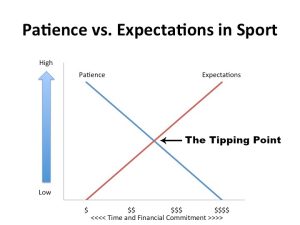
Sadly, that tipping point is arriving earlier. Parents chase the “best” academies at the expense of playing with friends and building a genuine, lifelong love of the sport. Some move their children away from better coaching purely to improve their chances of winning at the weekend. We now see children selected into pre-academy pathways at six or seven, more sessions crammed into the week, and early specialisation in a single sport, year-round, something we’ve written about elsewhere on the site and the risks it carries.
No one has really asked the children if this is what they want. Yes, they like competing, but they also want to play with their mates. Yes, sport is fun, but every single weekend. Yes, they know they need to practise but it still must be enjoyable. Yes, they want to win, but they also want the freedom to be creative, to try things, and yes, to get it wrong sometimes.
They never asked for it to become a job.
So, parents worry over every loss. Coaches worry about players leaving for the team that’s winning more. Adults on the sideline get anxious about results, frustrated with officials, and stressed when the “investment” doesn’t pay off the way they hoped.
Expectations climb, patience drops, and we hit the tipping point.
Yet the one thing that hasn’t changed is that these are still just kids. Kids who want to play, not sit on the bench because of a misplaced focus on winning. Kids who want the game to belong to them, not to the adults’ yelling instructions from the side. Kids who want to learn without fearing criticism for every mistake. Some of them, frankly, care more about the after-match snack than the score. We’ve lost patience with that too.
If we want to take some of the madness out of children’s sport, we need to rebalance the two. Patience should sit above expectations, not the other way round and ideally, our patience should never run out before theirs does. If a child decides, in their own time, that they’ve had enough of chasing something just out of reach, that’s their call to make, not ours.
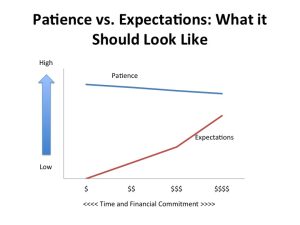
Here’s where I’d start.
- Have patience for the process
Time and money spent on a single sport, all year round, doesn’t change the fact that development is a long, uneven process with many strands. You can’t buy your way to it, and there’s no shortcut worth taking.
Think about it: if you wanted your child’s team to win every game this season, you could arrange it. Stack the squad, play weaker opposition, drop down a league. Job done. But the competition wouldn’t stretch them, they wouldn’t improve as quickly, and eventually they’d get bored. Winning constantly isn’t good for long-term development; children need the tight losses and the tight wins as much as the easy ones.
So, if we can agree that winning everything forever isn’t the goal, why do we panic over a handful of losses? A bad game, a bad week, a bad month, it’s not a red flag, it’s meant to happen.
- Have high expectations for the right things
Rather than expecting instant progress and flawless performances, we should be expecting coaches who are positive role models, and organisations that prioritise character, values and proper long-term development with winning kept firmly in its place.
It still surprises me how many well-intentioned parents stick with a “winning” coach who treats children poorly and models behaviour they’d never accept from their own child. Poor sportsmanship and shortcut development deserve far less patience than we tend to give them, especially when the team is doing well.
If a coach tells you character development “isn’t their job,” that’s worth listening to and walking away from. Plenty hide behind “developing winners” because building character is the harder, slower work. Parents who start expecting the right things will, over time, push coaches to deliver them.
We regularly hear from parents who’ve been told exactly how to behave on the sideline, only to watch the coach do the opposite. The organisation, the coaches and the parents all need to be pulling in the same direction.
- After every match or session, ask “what was good about that?”
Win or lose, ask what went well and what was learned. Even a missed penalty or a costly mistake has something useful in it if you help your child frame it that way. The more you look for the good, the lower your expectations of perfection drop, and the more your patience and theirs recovers.
Do this consistently and you build character, resilience, and gratitude. You reduce the fear of failure, and you build confidence. You give your child something far more valuable than a trophy: genuine optimism, which just so happens to be a trait shared by most of the best athletes in the world.
It’s time to demand more of the right things, values, role models, character, development, and less of the wrong ones: instant results and weekly scorelines.
Let’s push that tipping point further down the road and better still, let’s get rid of it altogether. Do that, and more children stay in sport for longer, develop further, and enjoy themselves while they’re doing it. Our stress levels drop, and children’s sport goes back to where it belongs, with the children.